Aleen Hughes and her big cats
There is a tale known to Lindsay’s citizens that Aleen Hughes, daughter of Sir Sam Hughes, once had a pet tiger cub that she paraded around the town of Lindsay on a leash. The story sounds outlandish and fabricated. The tale also varies on whether the animal was lion or a tiger. One cub or two.
Fact or fiction? Let’s dive into it.
Aleen [sometimes spelled Aileen or Aline] Victoria Ruth Ida Hughes was born in Lindsay on 10 June, 1894. Attending physician was her uncle, Dr. MacAlpine. The birth registration originally recorded her name as Ruth Ida Victoria but a note on the page makes a correction, changing her name to ‘Aleen’.
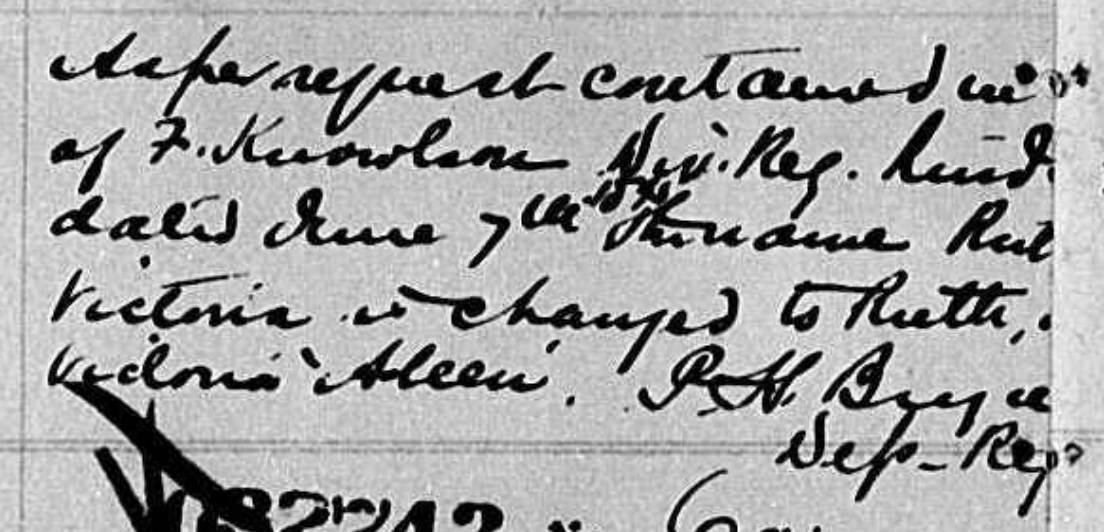
"Canada, Ontario, Births, 1869-1912," database with images, FamilySearch (https://familysearch.org/ark:/61903/3:1:939J-D8Y5-T?cc=1784212&wc=QZ3B-L5Y%3A1584203503%2C1584212708%2C1584221602 : 15 January 2016), Births > 1894 > no 25748-33470 > image 738 of 821; citing Archives of Ontario, Toronto.
Aleen’s parents were the notorious Sir Sam Hughes and his second wife, Mary Emily Burk. [Fun fact: Sir Sam was never Samuel. Not even on his birth records.] Aleen had two older siblings: a brother, Garnet and a sister, Roby. [Note: her name was not Ruby. It was Roby. This family does love unique names, which is interesting, but does pose a greater challenge for research.]
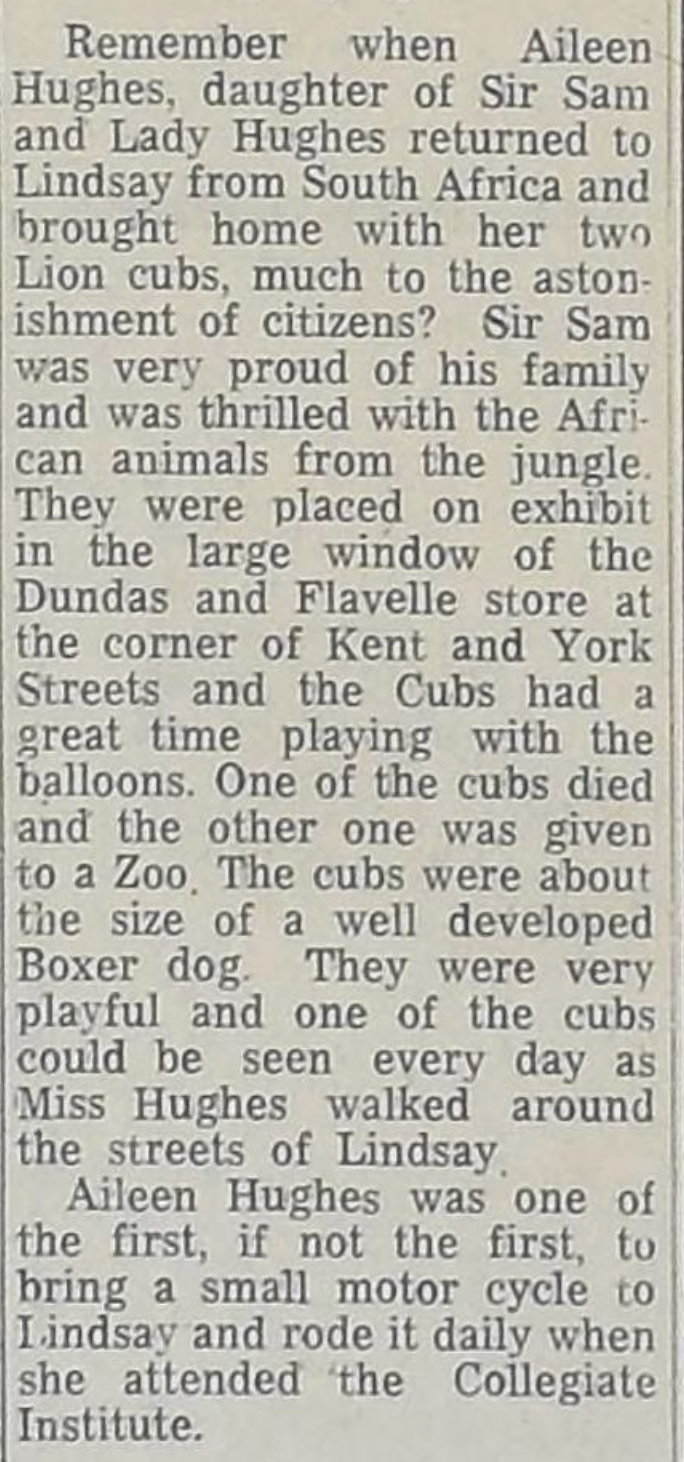
Aleen attended the Lindsay Collegiate Institute by way of motorcycle, possibly being the first to bring a motorcycle to Lindsay. Her classmates included Watson Kirkconnell and Stuart Flavelle. (Lindsay Post, 20 August 1912.)
Aleen Hughes joins the First World War
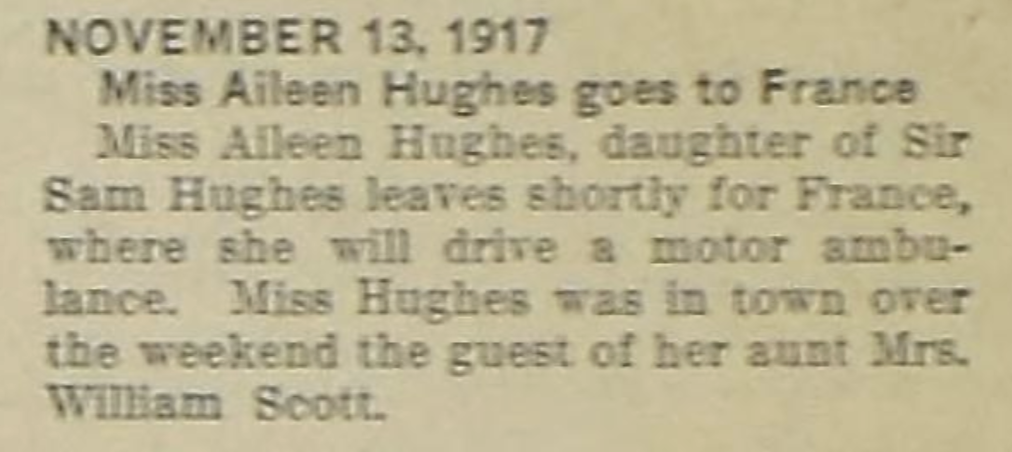
Lindsay Post, 13 November 1967
In addition to driving ambulances, Aleen was a driver for her father during the war.
Aleen was also part of the Voluntary Aid Detachment, a civilian unit that worked as nurses’ aides, ambulance drivers, and clerical staff. She aided the fight against the influenza epidemic.
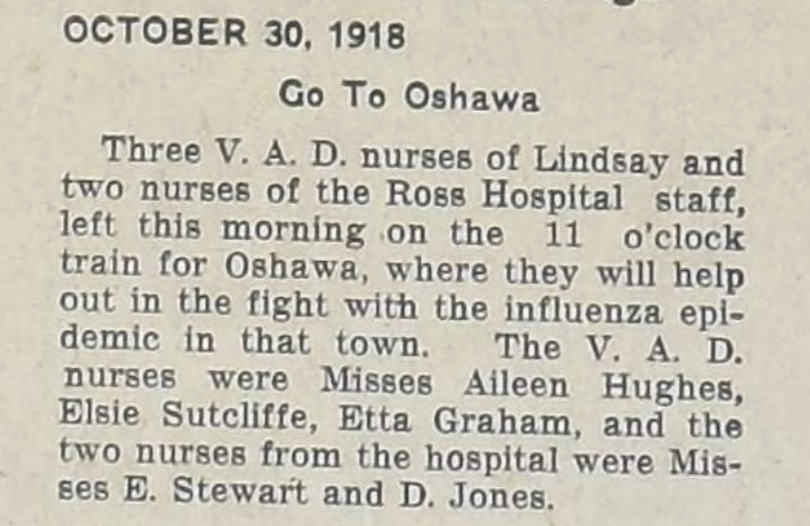
Lindsay Post, 30 October 1968
Aleen goes hunting for big game
Lindsay Post, 13 April 1968.
Aleen had always been fond of hunting and outdoor sports. As soon as she was old enough, she would take hunting parties up to Glen Eagle Lodge, the family property at Eagle Lake (which became Sir Sam’s ski resort). She shot her first game, a porcupine, when she was 10 years old.
After her father’s death in 1921, Aleen took up big game hunting on reserves in Africa. Towards the end of 1924, she spent several months in Kenya (then a British colony). The days started at 5:00am with a cup of tea, breakfast at 5:30am, and then they hit the trail at 6:00am. They travelled on foot, or crawled on hands and feet, unable to ride elephants because they weren’t domesticated, and the flies were too bad for the horses.
During her stay, Aleen hunted “a hartebeeste, three water buck, three impala, one buffalo, one rhinoceros, one wart hog, one eland, two Thompson’s gazelles, two Grant’s gazelles, one wilde beeste, one jackal, one hyena, two steinbuck, and two lions.” (Lindsay Post, 11 February 1927.) It was on this trip that she met her future husband and came home with her beloved trophy.
"She peered again into the dark thicket and fired at the dark shadow on the farther side…she ran wildly for the open and turned to wait for the lion to follow…she returned and despatched the second lion and carried off three fluffy, suspicious little nine day old cubs. She and her party were the heroes of that night’s supper table.” (Lindsay Post, 16 October 1925.)
She brought one cub home with her, and it became her treasured pet.
In his weekly column, Ford Moynes remembers there were two cubs and they were on display in the window of the Dundas & Flavelle store (right), but digging a little further, we find this is not entirely accurate.
An account of the hunting party’s return in April 1925 was captured in the New York Times. They rode the steamship Majestic of the White Star Line from Southampton. During the voyage, the ship’s surgeon was awakened by the ship’s butcher, “who told him to hurry because a lion cub was suffering from infantile convulsions. Dr. Beaumont prescribed medicine and the cub recovered…A.M. Creighton and Mrs. Creighton of Boston returned from a game hunting expedition in East Africa. They brought a lion cub from Nairobi, East Africa. Mr. Creighton said he killed seven lions and other big game…In the Creighton party were Miss Aileen Hughes of Toronto and James F. Clarke and Horace D. Bright of Boston.” (New York Times, 29 April 1925.)
Two of the cubs were brought out of Africa. One went to Boston. The other came to Lindsay. Aleen named her cub “Lucy Kenya Simba.” The cub was seen in the windows of Gregory’s Drug Store as well as Dundas & Flavelle’s store.
Unfortunately, the little lion cub passed away a year later, in the autumn of 1926. She had the cub mounted and presented it to the Royal Ontario Museum.
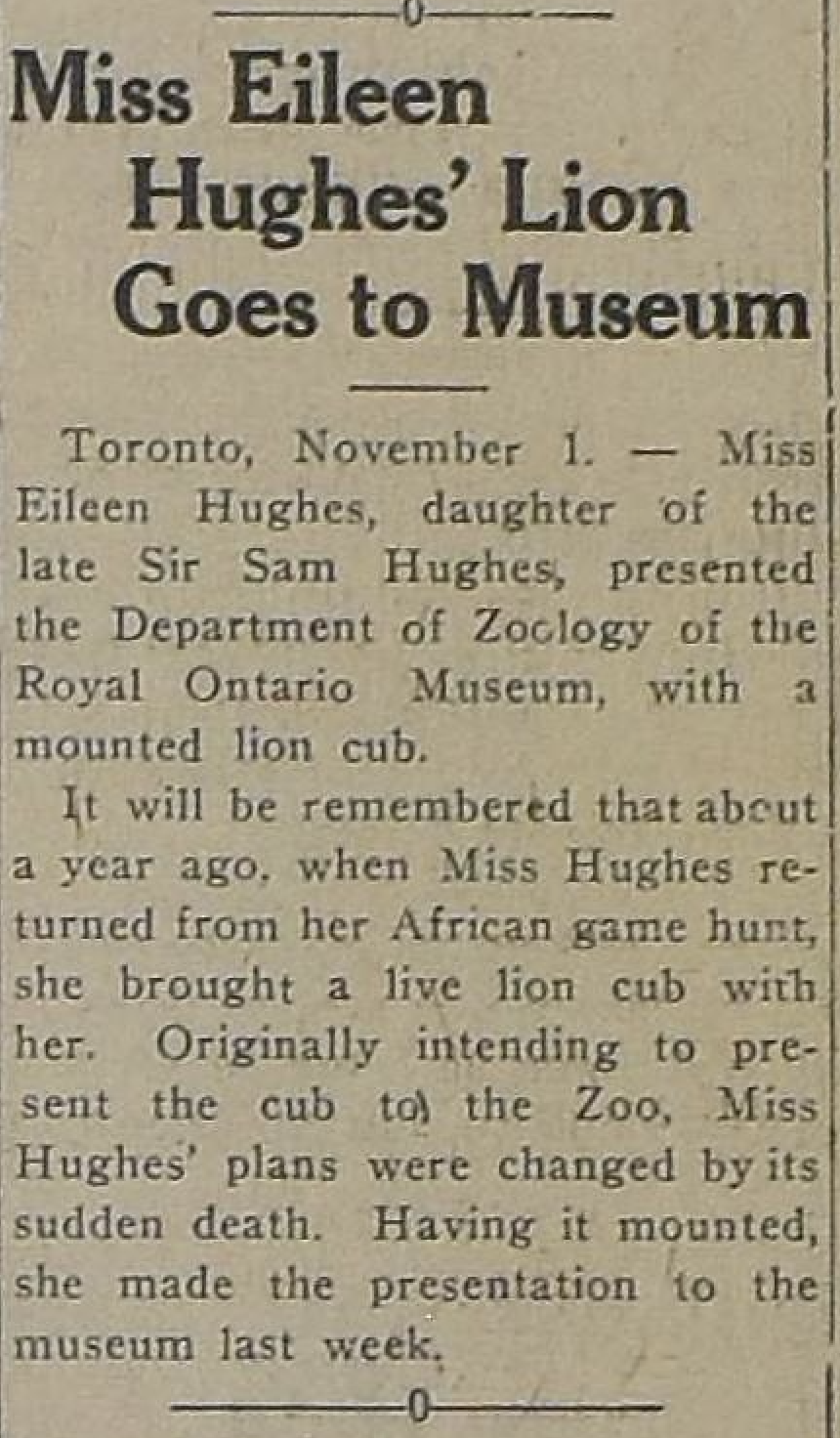
Lindsay Post, 2 November 1926.
The biggest and most elaborate social event of its kind in the history of Lindsay
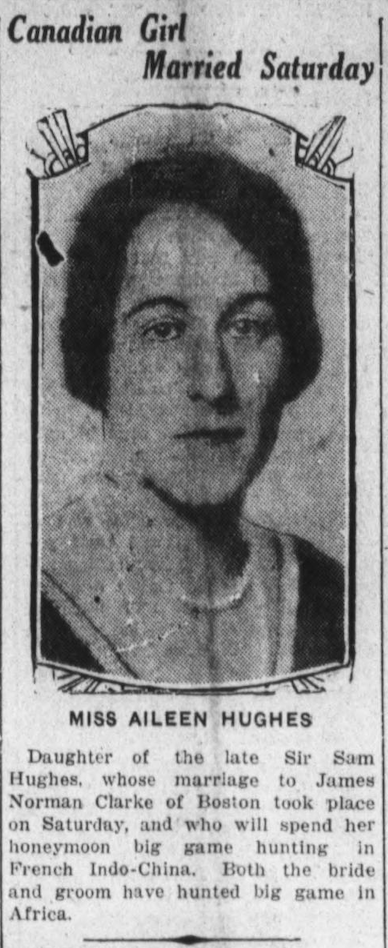
The Daily News, Nelson, B.C., 14 February 1927.
In March 1925, Aleen wrote to James F. Clarke that the trip had been “more thrilling and more wonderful than anything I ever dreamed of.” (Lindsay Post, 11 February 1927.)
They wed in Lindsay on 12 February 1927. The Toronto Star described it as the “biggest and most elaborate social event of its kind in the history of Lindsay.” (Lindsay Post, 11 February 1927.) The ceremony took place at the Cambridge Street United Church at 3:00pm, although guests started arriving at noon. The first four rows of pews were removed to allow for more space for floral arrangements. Additional flowers and foliage were draped over the organ loft with the top of the organ draped with three flags, including the Stars and Stripes. The ceremony was conducted by Rev. T. E. Holling of the United Church with assistance by Rev. Canon C.H. Marsh of St. Paul’s Anglican Church.
The wedding was noted by the media around the world, include Time magazine.
For their honeymoon, the couple went hunting for big game. This time, they went to China, wanting to shoot tigers. The bride’s trousseau consisted principly of gray breachers and hunting jacket, with a wide-brimmed gray felt hat.” (Lindsay Post, 16 July 1927.)
"At first I was afraid out there in the jungle alone. But one becomes accustomed to it. The third day, I saw the tiger across the clearing, then he went away. Toward dusk he again came ot the edge of the clearing. He was 15 of 18 yards away but I didn’t want to lose him. So I fired, the shot entered one nostril, went down the back to his skull and lodged in his shoulder. He turned and ran. I fired three shots, the signal for wounded tiger to the natives, about half a mile away, and they came running. I heard him fall, but it was too dark to search for him then so we returned in the morning and found him dead, the one shot killed him!” (Lindsay Post, 16 July 1927.)
After the honeymoon, the couple lived in Boston, Massachusetts.
This photo of Aleen and James was captured by the free press on 15 July 1927.
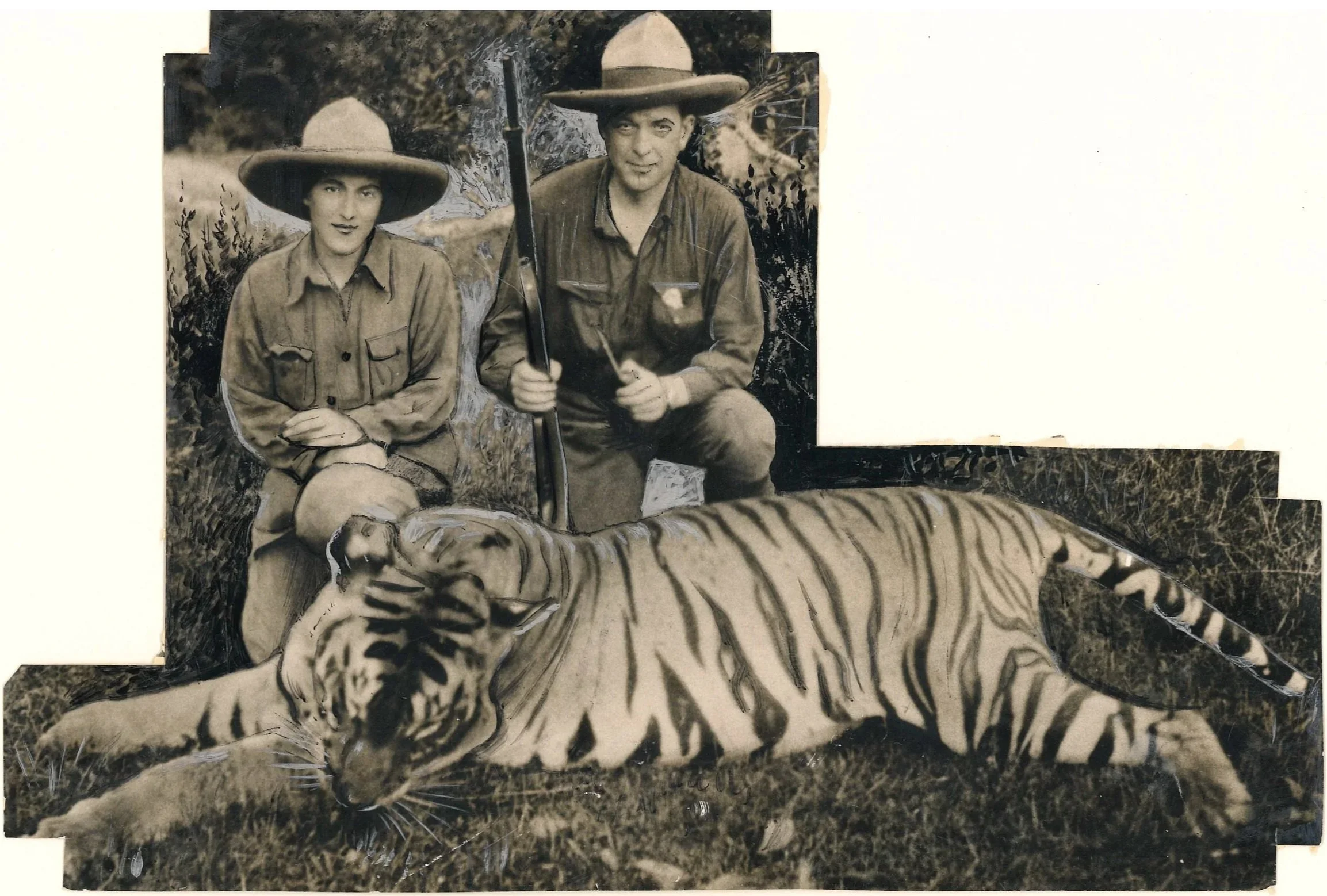
item: 2026.28