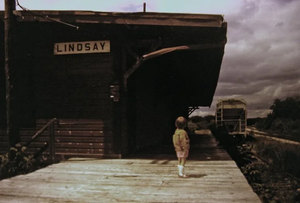
The Jennings Estate
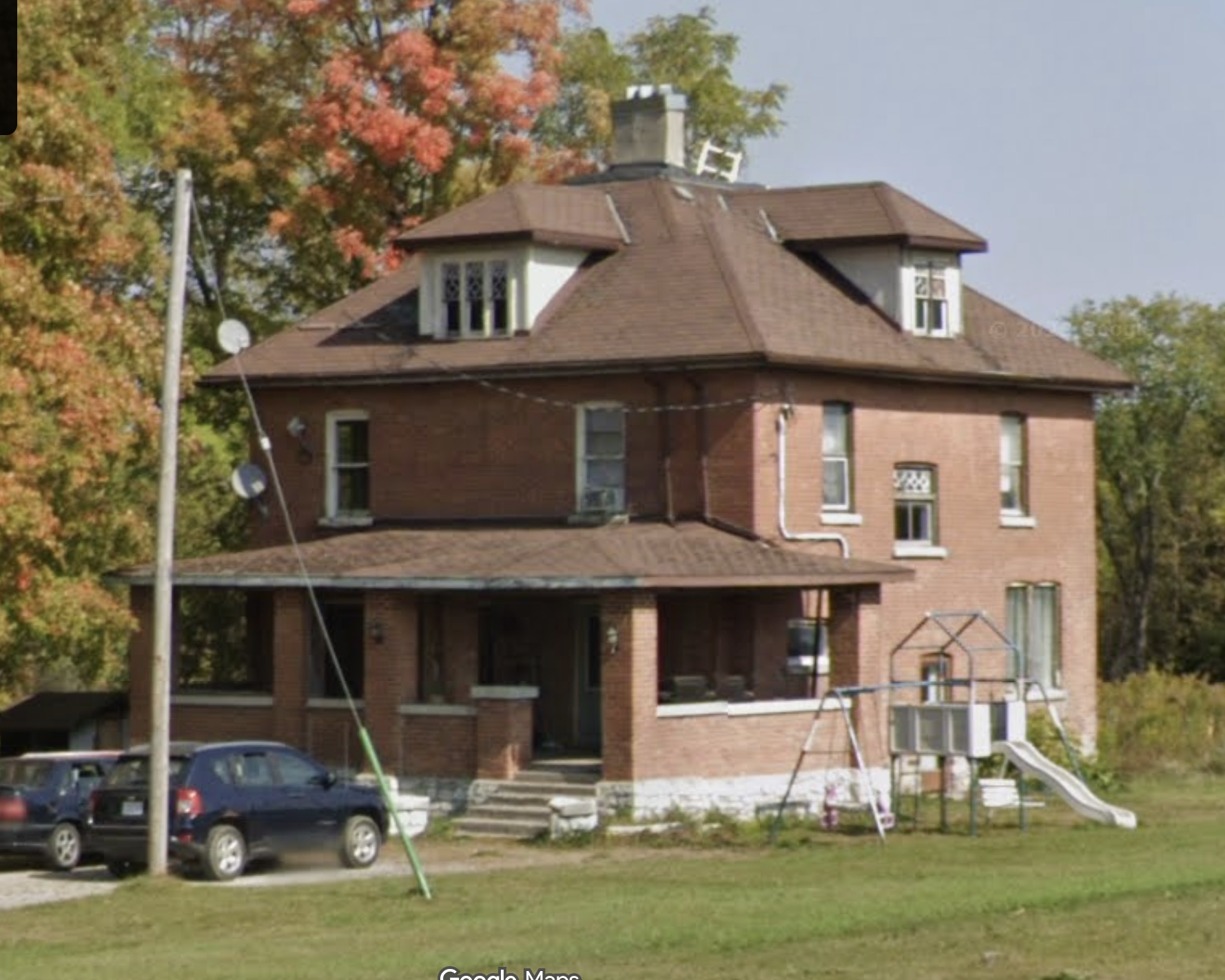
Image from Google image capture October 2023. © Google.
We are frequently asked for information about this property, and it’s understandable. It’s an older home on the edge of the creek, and yet, there’s no mention of it in Violet Carr’s history book, Land of Plenty, the history of Ops, or in Watson Kirkconnell’s Centennial History. We did a quick dive into the property’s history and discovered it was owned by prominent people to the area and a source of inspiration for current street names.
The Crown granted the original lot to Duncan McDonnell, which was a common method of payment to surveyors.
The lot was broken into two: an east half and a west half. (Interestingly, the east half ended up in the hands of the Honourable John A. Macdonald for a time (1852-1863), who owned many properties in the area.)
The west half went from John Lighe to Archibald Macdonell, and then to Robert Needham Waddell and then to his son, Montgomery Waddell.
Robert Needham Waddell was a sheriff in Ontario until he moved to Denver.
Montgomery Waddell (1862-1951) born in Port Hope to parents, Robert Needham Waddell and Angeline Esther Jones, lived in the Durham region then moved to the U.S. He married in New York in 1893 and became a naturalized citizen in 1916.
In 1888, Montgomery Waddell took out a mortgage against the property with Midland Savings and Loan in the amount of $7500. This could indicate the construction of a house. It’s also possible he mortgaged the property to fund his move to the U.S., since he had relocated by 1891, which means the house was built by Hopkins. Or, it’s possible Waddell built the house, but never lived in it. (Could his wife Angeline be a source of inspiration for Angeline Street?)
Further study of the architecture may be required to determine the date the house was built. The small-paned windows would support the theory of construction in 1888.
Hopkins
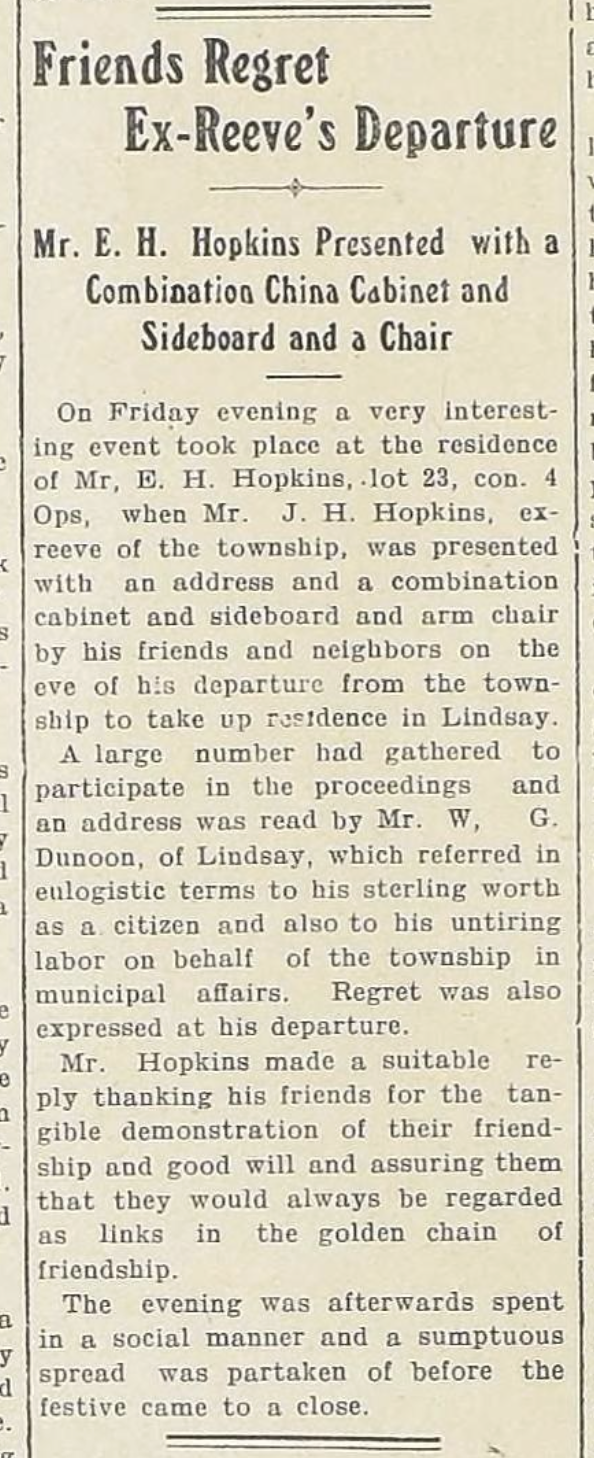
Lindsay Post, February 27, 1909.
Property was purchased by James Holmes Hopkins (1861-1940) in 1897 from Midland Loan and Savings Company. Hopkins was a reeve of Ops township. He married Mary Jane Corley in 1890. They had four children.
Lived on the property until 1909, when they moved to Cambridge St, Lindsay for a few years before moving to British Columbia
Jennings
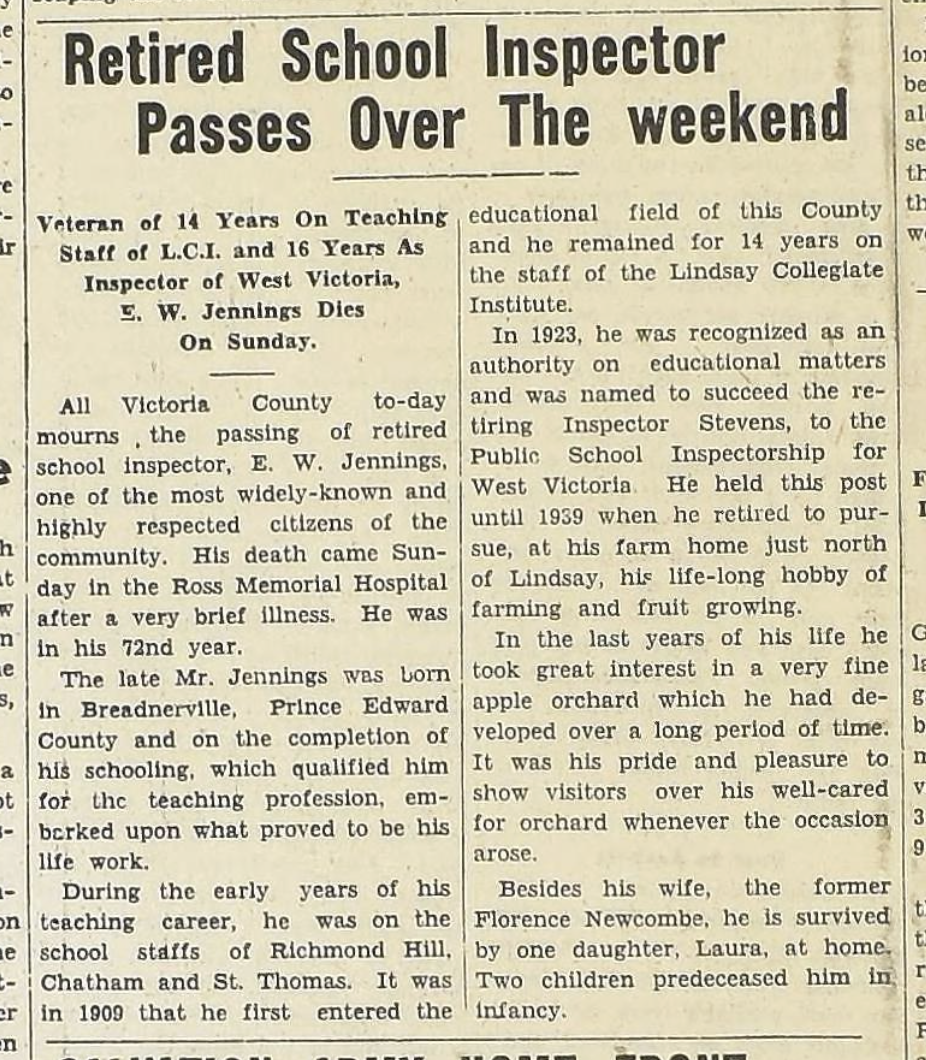
Lindsay Post, September 12, 1945.
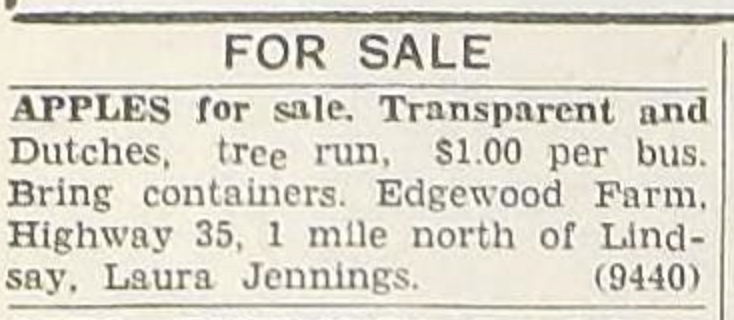
Lindsay Post, August 13, 1951.
Edwin William Jennings bought the property in 1912 from Hopkins. He made his wife, Florence Jane Newcombe a co-owner in 1921. Edwin bought part of the property from the Canadian National Railway in 1933.
In 1946, after Edwin’s death, Florence co-owned the property with their daughter, Laura Edwina Jennings.
Estate was called Edgewood Farm and was known for its orchards.
Laura became the sole owner around 1959.
Laura also ran Edgewood Kennels and sold puppies, kittens, and heifers.
At one time, there was a gravel pit in the area of Orchard Park, just off Applewood Crescent.
In the 1960s, Laura sold portions of the property to the Kawartha Construction Company. This was likely when the subdivisions were built.
Laura Jennings sold the property in 1986 to Francis and Sandra Kezar.
From the Jennings time, several names remain in the area: Jennings Creek, Edwin Drive, Edgewood Street, Applewood Crescent, Orchard Drive, Orchard Park Road.
[Note: Edgewood was also the name of the Boyd estate in Bobcaygeon.]