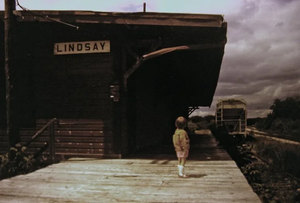
Carcross Residential School & its connection to Kawartha Lakes
Supplementary article to our current exhibit: A Collection Built on Relationships: Inuit Art from the Art Gallery of Northumberland’s Permanent Collection. Exhibit on site until the end of October 2026.
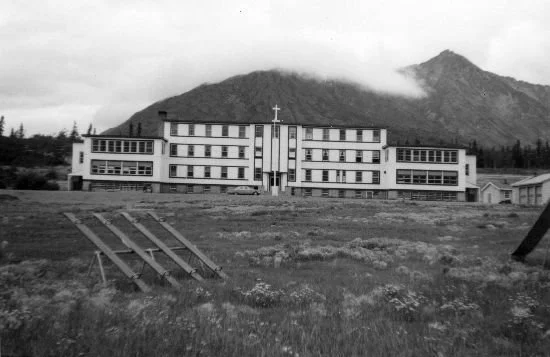
Yukon Archives, Edward Bullen fonds, 82/354, #19
The Anglican Diocese of Yukon was founded in 1890 and was responsible for the administration of residential schools within its boundaries. The schools were often underfunded and overenrolled and many former students have reported cultural, emotional, physical and sexual abuses.
Anglican missionaries, Bishop William Carpenter Bompas and his wife Charlotte, arrived at the abandoned mission at Forty Mile in 1892 to build a school and church. The Bompases took in a few children to board and their home became the Yukon’s first residential school.
In 1903, William Bompas and the Church Missionary Society established and managed the Carcross Residential School (also known as Chooutla), transferring the children from Forty Mile. In 1921, the Missionary Society of the Church of England in Canada (M.S.C.C.) took over management of the Carcross school. Additionally, the M.S.C.C operated the Shingle Point Residential School.
The federal government built a larger school at Carcross in 1911. The school had a reputation for poor health, harsh discipline, poor food, and unpleasant living quarters. Until the 1950s, the enormous amounts of wood needed to heat the school were supplied by child labour. In the 1940s, the principal admitted to strapping students so severely that they had to be held down. The school burned down in 1939 and was rebuilt in 1944. A more modern school was built in 1953, using steam from diesel generators for heat. The Carcross school closed in 1969 and was finally demolished in 1993.
“The children institutionalized at Chooutla were taken from communities throughout the Yukon, Northwest Territories, British Columbia, and Alaska. More than one thousand children had been institutionalized at Chooutla by the time it closed in 1969.” (https://niche-canada.org/2025/11/04/too-dangerous-a-job-forced-child-labour-and-wood-collection-at-the-chooutla-indian-residential-school/)
C.M. Bolger of the Northern Affairs Arctic Administration advised the federal government that “wherever possible children from ages 6 to 10 years should be kept as close as possible to their parents during their school career.” (Molloy, A National Crime, p. 254) He explained that the families made their livelihood by hunting and fishing, and when they finished school, so too would the children.
Bishop of the Yukon, Donald Marsh (no apparent relation to Henry Hooper Marsh), also appealed to the government, suggesting the approach to teaching the English language should follow in the footsteps of Wales, where the Welsh language had been retained at home, and thus the reason the language remained alive.
Both Bolger and Marsh made wise observations that were ultimately ignored. Once the children were inside the classroom, they were removed from their parents, culture, and language. Marsh tried to tell Ottawa they were out of touch with what was happening in the classrooms. “I have been repeatedly told by the teaching personnel, that their aim is to make the children ‘white’ and able only to take their place in the outside system.” (Molloy, A National Crime, p. 255)
“What of their future?” Marsh wrote. “What do you intend to do for them to make sure that they can get a job and live on the standards of a white person? They have been wrested from their way of life, and whether they like it or not, have been thrust into modern life… It became to them a compulsory thing, and we as a nation are responsible for having done this, and as such are responsible for the future of these people.” (Milloy, A National Crime, p.256)
One student at Carcross School was Alfred Semple. In 1930, at the age of 10, he went to live at the school with his sister Catherine. When she became sick, she returned home but Alfred stayed for nine years. When he returned home, he learned that his mother had died two years earlier.
“The year I came back from school, my father told me, “This year we are going to trap around Hungry Lake and you’re coming with me …My son, you don’t know how to talk our language well. You have forgotten much.” My father told me stories. When he read passages from the Bible, I used to answer him in our language. Six months we stayed out there. My father told me, “You talk good.” My father taught me everything. He taught me how to hunt, he taught me how to butcher the meat, moose or caribou, he taught me how to dry the meat, how to prepare the meat for food, and he taught me how to fish. Everything I know of the land, my father taught me.” McCartney, Leslie and Gwich’in Tribal Council. Our Whole Gwich’in Way of Life Has Changed / Gwich’in K’yuu Gwiidandài’ Tthak Ejuk Gòonlih Stories from the People of the Land. University of Alberta Press, 2020, p. 403, 409, 410. Available at Kawartha Lakes Public Library, 920.0092 Gwi -M.
Local Connections to Carcross:
Henry Hooper Marsh (1898-1995) was born in Lindsay, Ontario. He was educated for the priesthood at Wycliffe College at the University of Toronto. He was ordained deacon in 1924 and priest in 1925 for the Diocese of Toronto where he served until being elected Bishop of Yukon in 1962. He was Bishop of Yukon until 1967. He retired in Ontario and died in Cobourg.
After he married Margaret Dorathea Heakes (1912-1998), the Marshes served in the parish of St. Timothy’s in North Toronto for thirty years and focused the concern of their parish on the needs of our northern peoples. Bishop Marsh served on the executive of the Canadian Missionary Society, and Mrs. Marsh was subsequently elected President of the Diocese of the Arctic Women’s Auxiliary in 1948.
Margaret frequently travelled to remote settlements in the Arctic, where she encountered Inuit sculpture for the first time, and arranged for carvings to be created for church auxiliary sales. In addition to building her own collection of Inuit works of art, she was an accomplished bird watcher and field naturalist, a photographer, and a public speaker. She was also the editor of Notes & Nuggets and Northern Lights while living in the Diocese of Yukon.
Ruth Matthews of Lindsay - In 1959, Ruth Matthews went as a missionary of St. Paul’s Anglican Church to Carcross.
Aline Moen of Melbourne Street East in Lindsay - After graduating from nursing from the Calgary General Hospital, Aline answered the call of adventure and took a position as Public Health Nurse to the Indigenous People in the Yukon. She explained to a Lindsay Post columnist in 1967 that the federal government supplied her with a house, garage and a car. Part of her job took her to all the mission schools, including Carcross, where she immunized the children.
Margaret Tims (1870-1919) of Omemee - Born and raised in Omemee, where she was active at church and a Sunday school teacher. In 1901, Margaret married Charles Frank Johnson (1876-1935). In 1913, Johnson became manager of the residential school at Carcross and Margaret managed housekeeping, food and clothing. While they were at Carcross, their eldest son, Sheridan Johnson (1901-1915), was accidentally shot and killed. When Margaret died a few years later in 1919, she was buried next to him. Johnson was manager of the residential school from 1913 until his death.
In August 1909, Charles Johnson went on a near fatal journey with the Bishop of the Yukon of the time, Isaac O. Stringer from Fort MacPherson to Fort Yukon. The Rat River was freezing over where it wasn’t drying up, making the portaging messy. On September 20, as agreed, the Indigenous guides turned back, leaving Johnson and Stringer to go on alone. For six days they battled the ice in their Peterborough canoe, until finally choosing to abandon it and head across the mountains instead. The temperatures grew colder and food supplies ran out. They crossed partially frozen rivers and slept without a fire because they were above the tree line and crossing barren mountains. By October 8, they chose to return to the tree line where they could build fires and snowshoes, and possibly snare game for food. They set out again to find the pass through the mountains, but continued to miss it.
Excerpts from Stringer’s diary:
October 17 — Travelled 15 miles, made supper of toasted rawhide sealskin boots. Palatable. Feel encouraged.
October 18 — Travelled all day. Ate more pieces of my sealskin boots, boiled and toasted. Use sole first. Set rabbit snares.
October 19 — No rabbit in snare. Breakfast and dinner of rawhide boots. Fine. But not enough.
October 20 — Breakfast from top of boots. Not so good as sole. Very tired. Hands sore. Tied up Mr. Johnson’s fingers.
Finally, they found a river and concluded it was the Peel River. The next day they found sled tracks and followed them. They saw smoke from houses, finally found human habitation again.
Around the world, Stringer became known as the “Bishop who ate his boots.” A few years later, Johnson took the position as manager of the residential school at Carcross.
References and Further Reading:
McCartney, Leslie and Gwich’in Tribal Council. Our Whole Gwich’in Way of Life Has Changed / Gwich’in K’yuu Gwiidandài’ Tthak Ejuk Gòonlih Stories from the People of the Land. Edmonton: University of Alberta Press, 2020.
Milloy, John S. A National Crime: the Canadian government and the residential school system, 1879-1986, University of Manitoba Press, 1999.
Peake, Frank Alexander. The Bishop Who Ate His Boots: the biography of Isaac O. Stringer, Anglican Church of Canada, 1966.
The Lindsay Post:
1914 March 11. “Unique Publication from the Yukon.”
1931 April 27. “Is A Real Sight.”
1959 January 28. “Office of Holy Communion topic of guest speaker.”
1967 June 20. “Plain Talk with Gloria Barrett.”
Truth & Reconciliation Commission of Canada: findings & reports, 2015.
Watchman-Warder. 1919 September 11. “Newsy Notes from Emily.”
https://archives.nctr.ca/index.php/Carcross-Residential-School
https://yukon.ca/en/pathways-search-answers-and-healing-families-missing-children
https://indiandayschools.org/files/RG10_940-1_PART_1.pdf